
We Built the Machine. Now It’s Ours to Figure Out

A few days ago I was just sitting around when the same thought, one that millions of other people had already had, popped into my head: "Oh shit, this is happening right now." That weird feeling that we are the first generation to experience globally distributed, easily accessible, and mostly accepted generative AI.
I am somewhere in my 20s and have been using AI, especially ChatGPT, basically since its first public release. Over the years, I have somewhat noticed a decline in competence, not just in myself, but in the people around me as well. I started teaching myself programming when I was around 13 years old, like millions of other programmers before me, using documentation, Reddit, and Stack Overflow. But ever since AI has become more mainstream, I have been using these platforms less and less. Of course, it is a personal decision that I actively made, because we humans are creatures of comfort. The majority of the population will always take the path of least resistance, which is not inherently bad, but without any critical thinking or skepticism, it can lead to overreliance on tools and a diminished ability to solve problems independently.
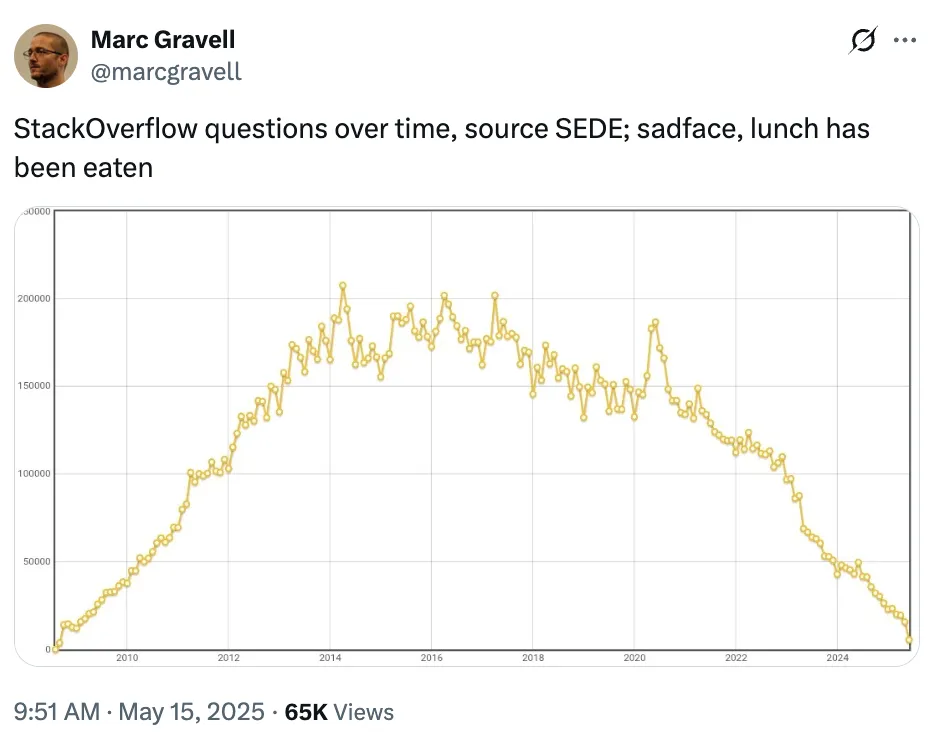
I mean, think about it. One hundred years ago, AI was basically unthinkable for the general public, while one hundred years from now, it will be so established that new generations will not know it any other way. Even now, with every baby born over the last three years, it is already part of life, but it is definitely not as widely distributed or normalized as it will be in the future. It is the dystopian future that science fiction has been imagining for as long as the genre has existed.
 Sydney Bradley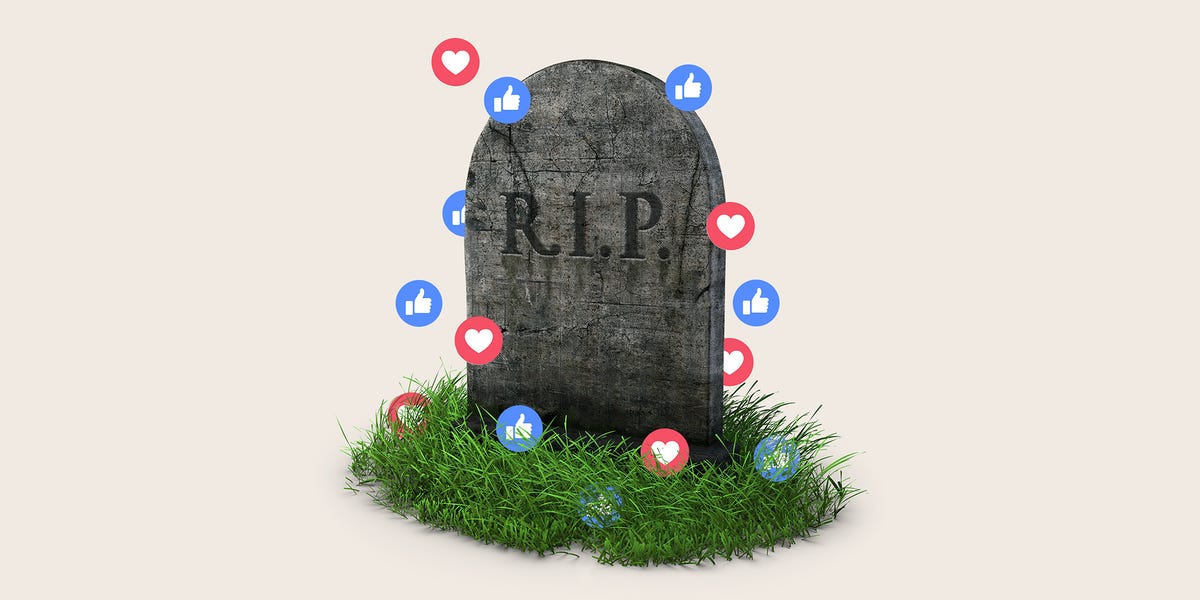
The company was granted a patent in late December that outlines how a large language model can "simulate" a person's social media activity, such as responding to content posted by real people.
"The language model may be used for simulating the user when the user is absent from the social networking system, for example, when the user takes a long break or if the user is deceased," the patent says.
And yet, despite all this, most of us barely notice how unusual it is. AI is already woven into our daily lives so seamlessly that the weirdness fades into the background. The majority relies on it to write emails, answer questions, generate code, and entertain us. The tools that once required effort, patience, and learning are now available at the click of a button. With every shortcut, every task we no longer have to figure out ourselves, there is a quiet erosion of the skills and resilience that shaped previous generations. It is both thrilling and unsettling to live in a time when intelligence itself can be outsourced. I see it constantly in my day-to-day life. Instead of performing basic tasks or a simple Google search, people turn to AI tools and fully trust their answers.
I’ve heard something along the lines of “Oh, but it doesn’t hurt anyone” more than once, yet people often fail to realize how much harm AI has already caused in our world. With fates at stake, I believe the use of AI deserves far more scrutiny than it currently receives.
 Tufan Neupane
WASHINGTON – To a layman, the citations filed in an appeal of a denied Social Security claim sounded plausible, if not outright impressive: Brown v. Colvin. Wofford v. Berryhill. Hobbs v. Commissioner of Social Security Administration.
Each citation bore a case number and the initials of a judge in the federal court for the District of Arizona.
All of those judges exist. The three cases do not.
It highlights how easily AI can produce outputs that sound credible, even authoritative, while being completely false. People see something that looks official and convincing and assume it must be real. It is a strategy that has been proven effective throughout history. From certain orange-looking political figures who mastered the art of confident misinformation to carefully staged propaganda campaigns, authority and presentation have often mattered more than truth. AI simply automates and scales this phenomenon. It can generate polished, persuasive content in seconds, without any inherent understanding of whether it is accurate.
But what can we do? How do we figure out the machine that we, as humans, have created and are using more fully every day, with no clear end in sight? Waiting for the AI bubble to burst is not an option, because carelessness and shortcuts will always find a way to persist. Simply opting out is unlikely to work either, since convincing enough people to stop using it is nearly impossible. What remains is to live with it consciously, to engage with it thoughtfully, and to do our best as individuals to maintain our judgment, skills, and critical thinking in a world where convenience is constant. Our challenge is not to stop the machine, but to navigate it responsibly, shaping both its impact and the kind of people we remain while using it.
So, I just wanted to rant a little about this. If you have any opinions on this, feel free to share them in the comments below.